I used to think acting on impulse was a sign of being ‘free-spirited.’ Until it started costing me things time, peace, sometimes even money. One example stands out, I impulsively made a commitment with a friend and immediately regretted it. But I couldn’t reach out to cancel because I felt guilty, I was the one who suggested it in the first place.
What was the commitment? You might wonder. One chill Tuesday morning last December, I was scrolling through the internet when I came across a video titled Top 10 Places to Visit in London. The places looked amazing, and I wanted to go right away but I wanted company. So, I messaged a friend who was living in another country but mentioned she’d be visiting London soon. She agreed to visit some of those places with me. But in the days that followed, my excitement faded. I didn’t want to go anymore. Still, I couldn’t tell my friend because I had initiated the plan. When she arrived in London, I never brought it up again. We didn’t end up going. I felt terrible about disappointing her, and my mind wouldn’t stop racing with guilt and regret. This was just one of many impulsive decisions I’ve made.
Understanding Impulsiveness
Impulsiveness isn’t just about making quick decisions. it’s about the discomfort of sitting still and letting thoughts simmer before acting. It means making snap decisions without much thought, your brain hits ‘send’ before you even finish the message. For me, impulsiveness shows up in habits, decisions, and even speech, with both good and bad consequences.
Often, impulsiveness feels like urgency, but not everything urgent is important. Have you ever noticed how some decisions happen so fast you barely realize it? That’s impulsiveness at work.
The turning point that made me realise the need for change
Everyone has a turning point. Mine came when I impulsively applied for a course I never attended. I didn’t think twice I just clicked “apply.” The course was important for upskilling and cost £250. But did I really need it? No. I didn’t take the time to think it through.
Because I had registered, I couldn’t avoid the course. It meant sacrificing my free time, time I usually reserved for rest. I never completed it or used what I might have learned. The time and money were wasted. That moment made me realize I needed to change. I could no longer afford to waste resources or peace of mind.
How I Started Tracking My Emotions
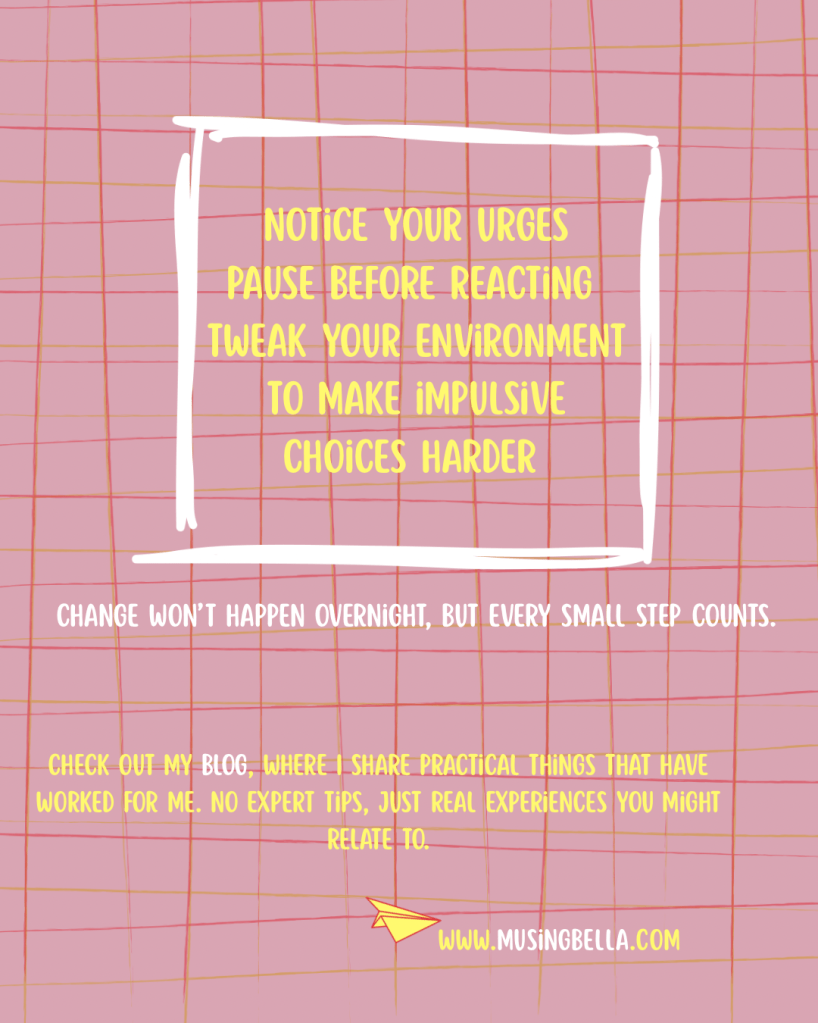
I began by tracking my emotions and becoming more aware. This helped me reflect and decide if a decision was truly important. Here’s how I did it.
1. I started by noticing, not fixing. Instead of jumping into solutions, I just paid attention. What triggered the impulse? Was it boredom? Anxiety? Avoidance? I didn’t try to stop it right away, I just let myself see it. That alone slowed things down.
2. I gave myself a pause button. I started practicing the art of the pause, literally. Before replying to a message, making a decision, or buying something, I’d take a deep breath and ask: “Is this coming from peace or pressure?” That one question saved me more times than I can count.
3. I noted things, not to be productive, but to process. Some nights, I’d note down what I did impulsively that day not to judge myself, just to understand the pattern. Over time, taking notes helped me trace emotions back to their roots, which gave me clarity I didn’t have in the moment (I used the notes app on my IPhone.
4. I replaced “act fast” with “respond slow.” This wasn’t easy, especially when I was used to chasing dopamine. But I started choosing slower things long walks, even doing nothing sometimes just to remind myself that urgency isn’t a lifestyle.
5. What didn’t help? Over-planning. Trying to ‘perfect’ my way out of impulsiveness just made me anxious. I had to unlearn the idea that self-control meant restriction. For me, it’s more about alignment, being in tune with myself, not battling myself.
6. Progress, not perfection. I still slip. But now, I recover quicker. I reflect quicker. And that’s growth. I’ve learned to celebrate the pause, even if the action that follows isn’t perfect. Which is good if you ask me.
What might help you overcome impulsiveness
You don’t need to fix everything overnight. Honestly, you don’t even need a full-on “stop being impulsive” plan. Sometimes, just knowing you have a choice, to act? or to wait? is enough to start shifting things. Few of the things that are helping me, may be of help to you as well:
Try the five-second pause.
Before you say yes. Before you click “buy.” Before you send the text or make that decision impulsively. Just breathe and count to five. It sounds tiny, but it gives your mind a little space to catch up with your heart.
Ask yourself “What’s the hurry?”
So much of impulsiveness is wrapped in imagined urgency. I started checking in with myself is this urgent or just loud? That question alone helped turn a lot of reactions into decisions.
Keep a judgment-free note.
Not for goals or productivity, just to track patterns. I felt ___, so I did ___. When you start seeing your own rhythms, the need to act on every emotion softens. This could be digital or physical note.
Let ‘doing nothing’ be an option.
This was big for me. I used to think indecision was weakness. Now, I see it as a signal to pause. Sometimes, not reacting is actually the strongest choice.
I’m not here to give a formula just an invitation, try listening to yourself a little longer before you respond to the world. That gap between impulse and action? That’s where clarity lives.
Still Learning, Still Growing
I still get the urge to act fast, say the thing, buy the thing, fix the feeling. That part of me hasn’t disappeared. But now, there’s space between the urge and the action. And in that space, I’ve found a kind of peace I didn’t know I was missing. It’s not about being perfectly measured. It’s about becoming more aware of myself, of what I need, and of what I’m really chasing when I act on impulse. If you’re in that place too, where everything feels urgent or loud or restless, maybe just ask yourself this, what would it feel like to pause? not forever, but just for a moment. Because sometimes, that moment is where the change begins.

 Musing Bella
Leave a comment